

Your Guide To Buying A Pool Table

Anatomy of a pool table
Buying a pool table is not much different
than buying a car—or any product you want to last for a long
time. The closer you look, the more you’ll see which
features are important to you and what will fit your
lifestyle. And although you can’t test drive a pool table,
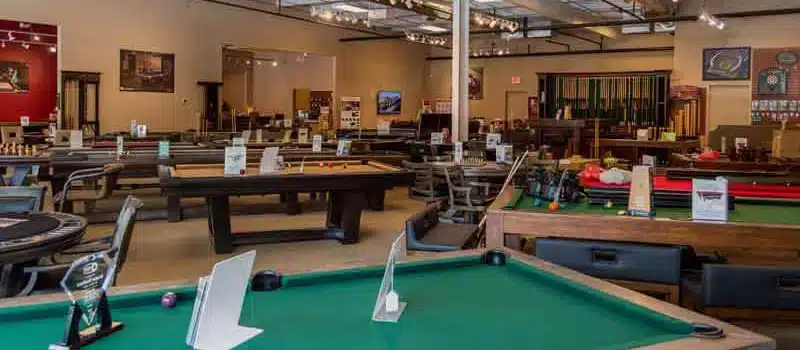
you can visit a dealer’s showroom to check out the variety
of models.
But before you go, it’s important to be a
knowledgeable buyer. That’s where this "how to buy a
pool table" guide comes in handy. Here you’ll find all
you need for making an informed decision.
Do you need a work truck, a family wagon or
a luxury car? The same considerations should be made before
deciding what pool table to buy. Some tables are made for the
constant use of professionals. Others are built with the
family budget in mind, yet can still hold up to the abuse kids
give to all your furniture. And still other tables are
beautifully ornate in design and a real showpiece for any
home. But whatever your personal needs or taste, there is a
style for you.
LIFESTYLE AND ROOM CONSIDERATIONS
Pool tables are available in a variety of
materials, styles and colors. Traditional solid hardwoods can
be stained in colors ranging from whitewash to dark mahogany.
Contemporary high pressure laminate (FORMICA® and Wilsonart®
for example) covered tables come in a spectrum of colors. And
all can be covered in the cloth color of your choice. So
consider your existing room decor. You may even want to bring
a picture of the room or your fabric and carpet samples with
you when you shop. Many dealerships have experience helping
customers discover the perfect table for them.
Before buying a pool table ask yourself,
"Will it fit in our room?" You wouldn’t buy a
large SUV and expect it to squeeze into your one-stall garage.
Likewise, you’ll want to make sure your table has ample
playing room around it. An approximate five-foot perimeter is
suggested, so measure your space to ensure a perfect fit. If
you’re concerned a large slab of slate won’t fit through
your doorway, tables built for the home use three-piece slate.
Almost the only time one-piece slate is used is on coin-op
tables.
For a pool table to be considered ‘regulation
size’ the length of the playfield is twice the width—and
most regulation-size pool tables are built in 7’, 8’ and 9’
lengths. No matter which length you choose, be aware that
minimum space requirements will change depending on the size
of the cue you select.
For specific room sizes, use the following
measurements:
Key: Use
[A] for 48" cue
[B] for 52" cue
[C] for 57" cue
• for a 7’ table
[A] allow for an 11’ 6" x 14’ 6" room
[B] allow for a 12’ x 15’ room
[C] allow for a 13’ x 16’ room
• for an 8’ table
[A] allow for a 12’ x 15’ 6" room
[B] allow for a 12’ 6" x 16’ room
[C] allow for a 13’ 6" x 17’ room
• for a 9’ table
[A] allow for a 12’ 6" x 16’ 6" room
[B] allow for a 13’ x 17’ room
[C] allow for a 14’ x 18’ room
WHAT TO LOOK FOR IN A POOL TABLE
Solid hardwood and veneer.
What’s the difference?
Veneer is a thin layer of solid hardwood bonded to a laminated
wood subcore. The advantage is its value. It has the
appearance of solid wood without the cost.
Solid hardwoods are heavier, stronger and
are better able to withstand stresses and wear common to pool
tables. They come with a higher price tag, and can be
intricately carved. Compare table weights, as weight reflects
the quality, design and materials that went into the
construction.
Laminated lumber or dimensional lumber.
Laminated lumber is hardwood stock that is glued with the
grain of each piece opposing the other. The result is a single
piece of wood that is less susceptible to warping, bending,
twisting or splitting due to heat and humidity—unlike
dimensional lumber which is less expensive but does not have
the strength to hold up over time.
Interlocking frame and slate support.
A better built table has center beams that run the length
of the table and interlock with the cross members. This
stabilizes the slate and cabinet of the table with
substantially greater support, and distributes the weight
evenly throughout the table. Cross members are necessary to
ensure the best support for each piece of slate. Note that
some main beams are purely cosmetic—drop-in vs. full length—offering
little or no support to the slate.
Cabinet and leg joinery.
Look for a securing system that ensures an exact cabinet
fit. Two examples of the strongest systems are MLD (Machined
Locking Dowels) and the more traditional method of building
tables (and most fine furniture), with mortise and tenon
joinery. Check out how the legs are mounted to the cabinet.
Some manufacturers use corner leg joinery made of stamped
sheet metal. Using more securing bolts will provide much
greater stability.
Details and craftsmanship.
How is the table put together? Is it just stapled and
glued together, or is it glued, screwed and bolted for greater
strength? Is the table designed with minimal structural
support? Tables that last are those that are built to
withstand the rigors of years of play.
Get on your back and crawl underneath the
table. This is where one of those mechanics’ creepers would
come in handy. Look up and notice the slate. Either Brazilian
or Italian slate will offer an acceptable playing surface.
Italian slate is recognized as the finest playing surface and
is used in sanctioned tournament play. High-end tables use
slate backed with 3/4" engineered wood. It provides
better slate protection and sound absorption.
Take a close look at the wood. Make sure the
rails, blinds, cabinet and legs are made using the same type
of wood. Some manufacturers use different, cheaper wood
components leaving you, for instance, with a table whose legs
look different than the cabinet.
On contemporary styled pool tables, look for
the use of metal hardware on the cabinet and rail corners vs.
plastic. Feel the pockets. Hard plastic can crack with wear.
Make sure the pockets are made of supple soft rubber-like
plastic.
Rails and cushions
Check out the rails. Look at the width and profile. The
use of laminated maple core rails is preferred on pool tables.
It minimizes rebound vibration and produces exceptional ball
response. Whereas rails with a soft core won’t give you the
same fast play.
Ask what technology is being used in the
cushion. K66 full profile cushion is the industry standard.
The cushion should also be canvas-backed. This helps the
rubber adhere the cushion to the wood rail for durability and
more accurate and consistent play.
Table finishes and laminates
You’ll want a finish that not only looks great, but
offers the best protection against scratches and overall wear
and tear. On family/rec room tables look for high pressure
laminates like FORMICA® and Wilsonart® on the rails. They
are impact resistant and resist burns and scratches. The
laminate of the rails should match the vinyl of the cabinet
and legs, which are less exposed to direct play.
Hardwood tables—veneer or solid—should
be finished to fit your needs. A catalyzed coat offers a
smooth, durable finish. However, a UV cured finish, the latest
in furniture technology, offers the most durable and
long-lasting finish.
Warranty or guarantee
Tables built to last will offer a lifetime guarantee, if
installed by authorized personnel. When’s the last time you
were offered a lifetime guarantee on anything?
|